
Theory of change
PROBLEM
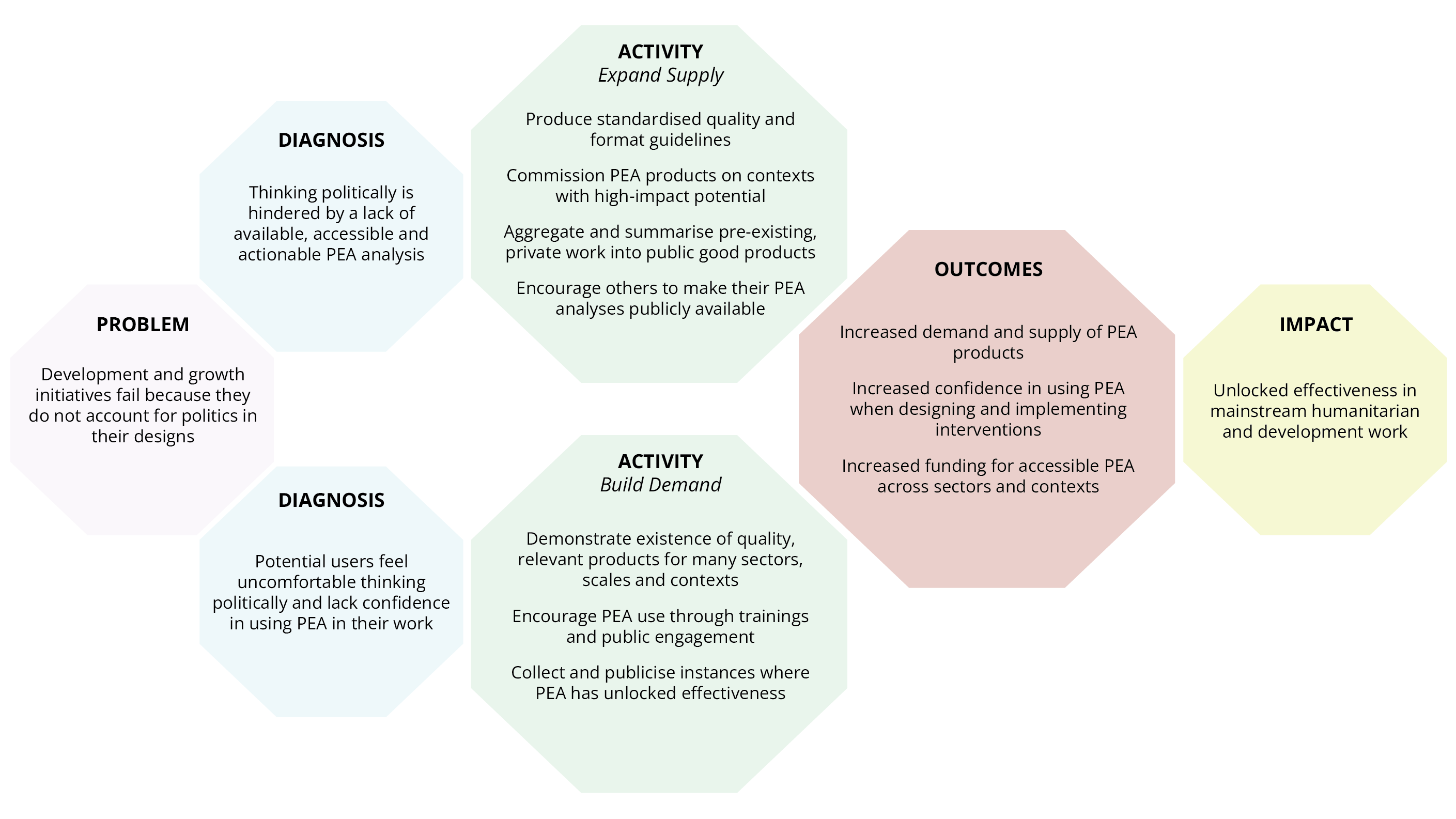
Too many initiatives and reforms aimed at generating growth and development fail to live up to their promise. Results fall short, funds are wasted, bad systems are sustained, and living standards are not improved as a result. These poor outcomes are often attributed to a ‘lack of political will’ rather than inadequate policy or programme design.
DIAGNOSIS
The fault in these designs is their inattention to politics. Technocratic approaches remain the norm in mainstream growth and development work. These may be first best for overcoming the engineering challenges to progress, but they founder upon implementation because they do not sufficiently account for the local political factors, systems and constraints that will stand in their way.
SOLUTION
We contend that integrating political considerations into all stages of design and implementation is key to increasing effectiveness. This holds true regardless of the source of funds. Political economy analysis (PEA) is a well-established set of tools for doing this. Politically informed strategies that work within the existing elite bargains and distributions of power in a country, or that disrupt them by putting forward politically feasible alternatives, are more likely to unlock ‘political will’ than policies which are politics blind. In contrast, technocratic reforms often directly challenge the interests of powerful elite groups. This undermines them from the start, causing them to fail.
I’m sold. Why don’t we do that?
PROBLEM
Quality PEA isn’t easily accessible. Many topics have never been analysed. The analyses that do exist are largely bespoke reports produced by private consultants for paying clients, typically government aid agencies and therefore associated with foreign policy. They are tailored for internal use, are often more descriptive than action-oriented, and are rarely shared. At the same time, many actors feel uncomfortable whenever politics is mentioned. They do not have the understanding, skills, or risk appetite to engage confidently with political constraints, and thus remain in technocratic spaces where they feel safe.
DIAGNOSIS
As a result, PEA has both supply side and demand side constraints that prevent widespread adoption. Not enough quality products are being produced, and those that do exist remain under lock and key. This prevents cross-learning and excludes less-resourced actors from vital information. At the same time, many potential consumers of PEA believe it is not for them as they ‘don’t do politics’.
SOLUTION
PEA for all! Tailored products will always have a use case. But analysing broader national and sectoral political constraints, and making findings and recommendations freely available to all stakeholders, has the potential to lift all boats. Open PEA provides less-resourced and more risk averse actors (whether country governments, local civil society, smaller donors, foundations, UN, IMF) with quality analysis, allows technocrats and PEA sceptics to experiment with political thinking at no cost and limited risk, and more generally enables conversations about political constraint, thereby shifting ‘thinking politically’ from taboo to norm.
Gotcha. How do we get there?
Build it (and communicate it) and they will come. Here’s our roadmap to get politics out of the shadows and into the mainstream.
Create a reliable focal point. PEA is rarely found on existing document exchanges in the growth, development or humanitarian sectors. Until it becomes normal to share such analyses, we will curate a growing repository of Open PEA products, case studies and other resources on our own site. Hosting these at arm’s length from country contexts should also reduce risks to authors and users.
Expand supply. To get more PEA out in the open, we will:
- Develop and release standardised quality and format guidelines for analysis (the Open PEA method) and apply these ourselves.
- Commission products to serve as proofs of concept in areas where the potential for uptake and impact is high to demonstrate value.
- Aggregate and summarise high-quality, pre-existing work from other sources to produce public good, mainstream products from private analysis.
- Encourage PEA funders and producers to commit to making available public versions of their analyses (so openness becomes a norm for PEA).
Build demand. To widen the user base and boost uptake, we must:
- Provide quality, relevant products across a wide variety of sectors and contexts.
- Support ‘thinking politically’ and PEA use through online and in-person convenings, trainings, discussion, and (social) media engagement.
- Collect and publicise impact case studies of where PEA has unlocked effectiveness by helping make policy and programmes more impactful.
Leverage success to scale funding, output and impact.
- Demonstrate use of the Open PEA platform and materials by key stakeholders.
- Collect testimonies, endorsements, references and other evidence of PEA uptake and impact.
- Develop case studies showing where and how PEA analysis has credibly influenced debate, policy decisions, and investment.
- Estimate PEA’s RoI to further build case for investment in the age of small aid.
- Attract new funders who see the potential of incorporating political thinking into mainstream growth, development and humanitarian work to grow the platform further, expand its output, and diversify its product offerings.